Technical specifications — an explanatory guide
Every EV charger comes with a list of technical specifications. This page explains what each parameter means, in plain language, so you can make an informed choice — whatever your technical background.
- Circuit breaker
- Residual-current device
- Power relay
- kWh meter
- PWM pilot (IEC 61851)
- Limit: 7.4 / 11 / 22 kW
The EVSE station does not convert the current. It delivers AC safely and in a controlled way. The AC→DC conversion happens in the car's OBC, which limits the maximum power you can receive.
- MCB + RCD
- The two protective devices fitted in the distribution board ahead of the charger: the MCB (circuit breaker) and the RCD (residual-current device). Together they protect the circuit, the cable and the user.
- Circuit breaker (MCB)
- Miniature Circuit Breaker — automatically cuts the current in the event of an overload or short circuit, protecting the cables and equipment from overheating.
- Residual-current device (RCD)
- Residual Current Device — detects current leakage (e.g. to earth) and disconnects the installation within milliseconds, protecting against electric shock.
- EVSE
- Electric Vehicle Supply Equipment — the charging station itself. It does not convert the current; it delivers AC safely and in a controlled way, and communicates with the car.
- PWM pilot
- The control signal (IEC 61851) between the station and the car. It is used to negotiate the maximum current delivered and to confirm a safe connection before charging starts.
- OBC (On-Board Charger)
- The AC→DC converter built into the car. Its limit (e.g. 7.4 or 11 kW) sets the maximum speed regardless of how powerful the station is. DC stations bypass the OBC and deliver direct current straight into the battery — which is why they can reach hundreds of kW.
Times are estimated for a 60 kWh battery (e.g. Renault Megane E-Tech), a typical charge from 20% to 100% and 90% efficiency — the same formula as in the configurator on the home page. The actual time may vary with temperature, the battery's condition and the limits of the car's OBC.
Specifications
The same specifications appear on every charger's page — you can use them to compare models with each other. Below, each parameter is explained in plain language.
General
Power & Electrical
Practical comparison for a car with a 60 kWh battery (e.g. Renault Megane E-Tech), charging from 20% to 100% at 90% efficiency:
- Ordinary Schuko socket (2.3 kW) → ~23 hours
- 3.7 kW charger → ~14 hours
- 7.4 kW charger → ~7 hours (ideal for overnight charging)
- 11 kW charger → ~5 hours
- 22 kW charger → ~2.5 hours
Typical values for home use: 3.7, 7.4 or 11 kW. 22 kW chargers require a three-phase installation.
Connector & Cable
The physical shape of the charging plug. Standards differ by current type (AC/DC) and by geographical market. Chargers sold in Romania use almost exclusively Type 2 (AC) and CCS2 (DC fast charging).
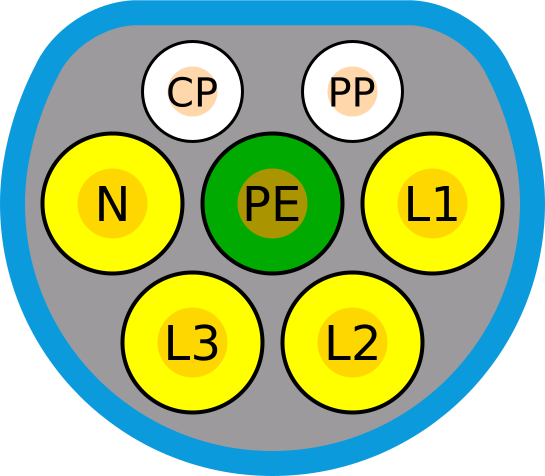
The European standard — Tesla, VW, BMW, Audi, Mercedes, Renault, Hyundai, Kia and every new EV sold in the EU.
IEC 62196-2 ↗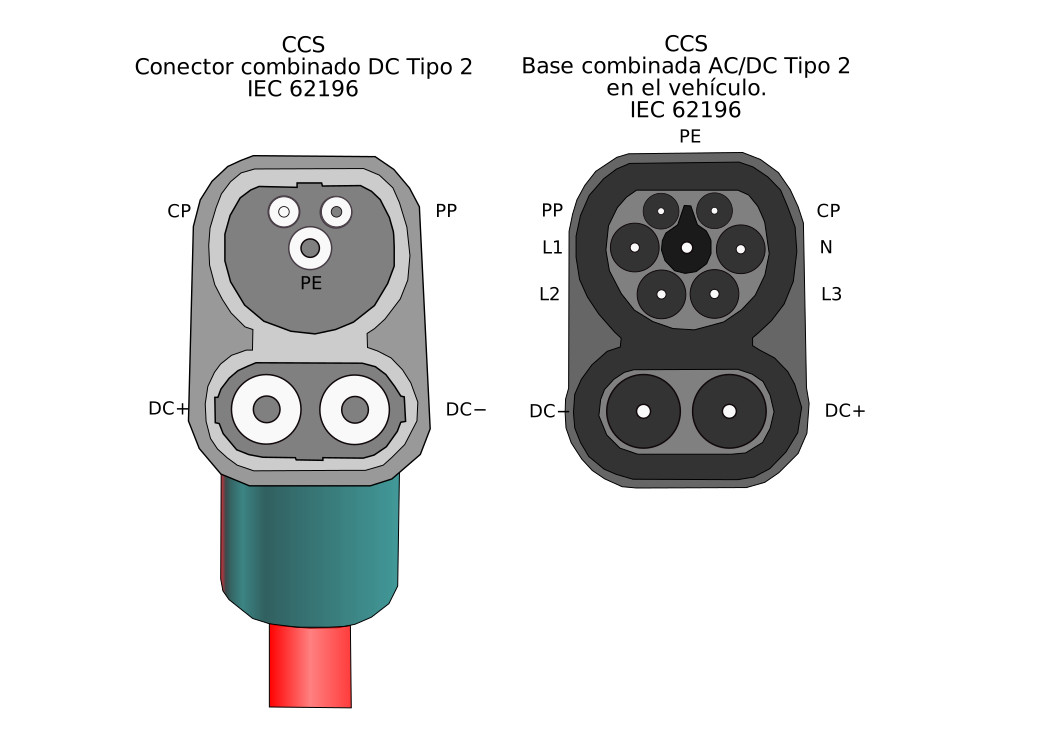
The European standard for DC fast charging. The same cars as Type 2, plus the large DC connectors below the AC plug.
IEC 62196-3 ↗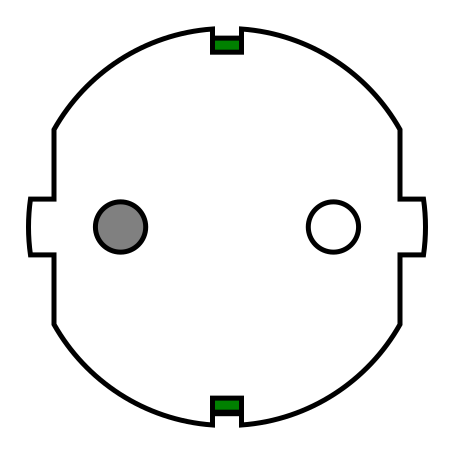
The ordinary household socket — the slowest way to charge. Used only as an emergency fallback.
IEC 60083 / CEE 7/4 ↗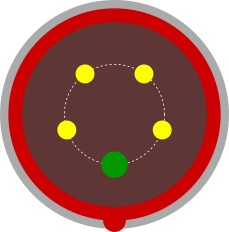
Three-phase industrial socket (blue 16A / red 32A). Campsites, vehicle fleets, installations without a dedicated charger.
IEC 60309 ↗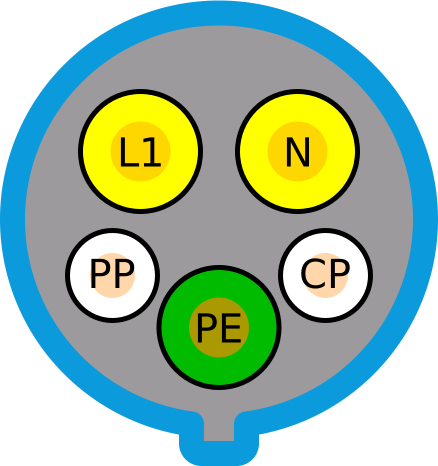
Nissan Leaf (older generations), Mitsubishi Outlander PHEV, some imports from Japan/the USA.
SAE J1772 / IEC 62196-2 ↗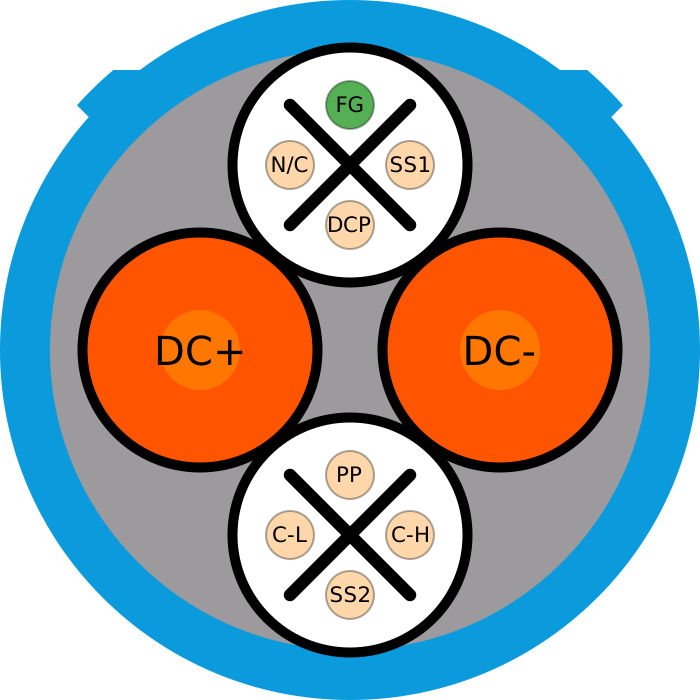
Japanese DC standard, in decline in Europe. Nissan Leaf, Mitsubishi. A charging network in decline compared with CCS2.
IEC 62196 / CHAdeMO ↗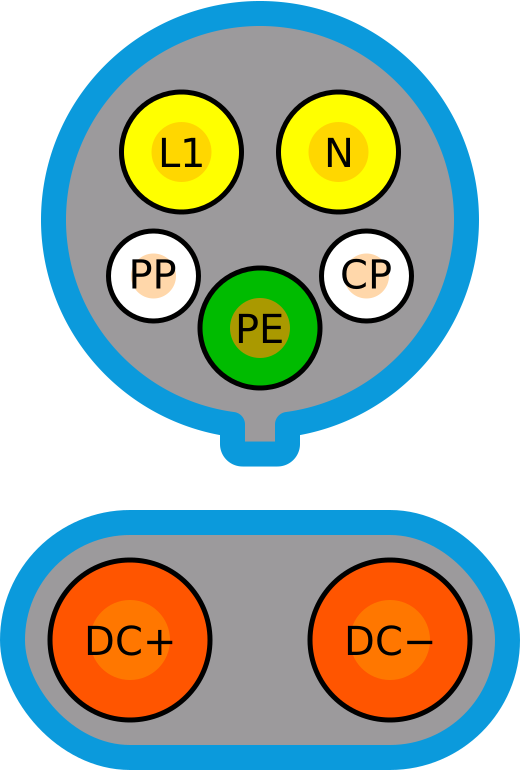
The North American version of the CCS standard. GM, Ford, Chrysler. Rarely seen in Romania.
SAE J1772 / IEC 62196-3 ↗Tesla in Europe: Since 2022, every new Tesla sold in the EU uses Type 2 (AC) and CCS2 (DC) — the same as all other European cars.
Protection & Build
Connectivity
Smart Charging
Access Control
Display & UI
Certifications & Commercial
Included accessories
These specifications show what is included in the product's standard package, at no extra cost.
Accessories
Each accessory is a product in its own right, with its own page (/en/accessories) — it can be bought separately or added to the cart together with a fixed charger. Its specifications are grouped in the same format as for fixed chargers: Power & Electrical, Connector & Cable, Protection & Build. Below is what each field means.
Professional installation
An optional professional installation service, available for chargers marked “Installation available”. Pricing is configured globally and applies to all compatible chargers.
On site, the electricians carry out the whole installation: laying the cable, connecting to the distribution board (MCB + RCD, if required), fixing the charger, connection and full testing. If conditions on site differ from the estimate — a longer distance, a more difficult route or higher-grade materials — the difference is discussed on the spot and, with your agreement, invoiced separately.
See the full step-by-step installation guide →
Check attestation no. 16986 in the ANRE public register ↗
We currently cover a radius of ~50 km around Cluj-Napoca (Cluj-Napoca, Florești, Baciu, Apahida, Turda, Câmpia Turzii, Dej, Huedin). Nationwide expansion, through a network of ANRE-authorised partners, is in progress — if you are outside the radius, you can still contact us. (This radius is the area the team physically travels to — separate from the cable distance limit below, which relates to the online price calculation.)
Services included in the fixed price:
- Cluj-Napoca and surroundings (~50 km)
- Wall or pole mounting
- Connection to the electrical panel
- Supply cable (first metre included)
- Testing and commissioning
- 2-year installation warranty
If the cable route exceeds the first metre included, a supplement per extra metre is added automatically.
Frequently asked questions
What is the difference between a single-phase and a three-phase installation?
For overnight charging at home, 7.4 kW single-phase is enough (a 60 kWh battery, 20→100%, in ~7 hours). Three-phase matters if you want fast charging in a few hours or have several cars. Check what type of grid connection you have before buying an 11 or 22 kW charger.
What is the difference between 7, 11 and 22 kW chargers?
- 7.4 kW (single-phase) → ~7 hours. Ideal for overnight charging at home.
- 11 kW (three-phase) → ~5 hours. A good balance between speed and installation cost.
- 22 kW (three-phase) → ~2.5 hours. The fastest AC option, but it requires a three-phase grid connection and a compatible OBC in the car.
Note: the actual speed is limited by the car's OBC. If the car accepts a maximum of 11 kW, a 22 kW charger will still charge at 11 kW.
Can I charge my car from solar panels? How do I choose a suitable charger?
To match your existing photovoltaic system, check:
- The phase — a single-phase charger suits a single-phase inverter; for three-phase systems, a three-phase charger spreads the charging evenly across the three phases.
- Compatibility — some chargers integrate natively with popular inverters (e.g. via Modbus/API, reading production in real time); others work universally with a CT sensor fitted at the grid connection.
If you tell us which inverter you have, we will recommend a model that suits your installation.